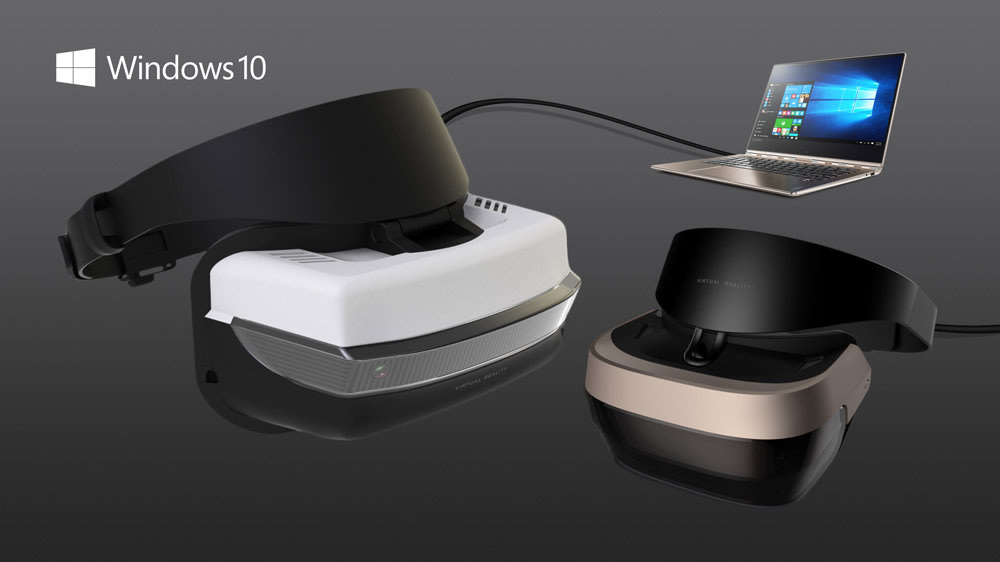
There's still much we don't know about Microsoft's plan to deliver virtual reality in Windows 10. At this point, we've heard it'll start with $299 headsets from a variety of PC manufacturers, and support for the Windows Holographic VR platform will arrive in in the Windows 10 Creators Updatenext year. There's plenty left up in the air beyond that (we'll likely hear more during an event next month). For now, we've got a sense of minimum PC requirements to run VR experiences, The Verge reports.
According to the "Windows Holographic First Run" application, which is available in the most recent Windows Insider test builds, the VR platform will need at the minimum 4GB of RAM, a DirectX 12 graphics card, USB 3.0 support and four CPU cores. If you've got a dual-core CPU with hyper threading (which appears as four different cores in Windows), you'll probably be safe as well.
Of course, Microsoft's final specs will likely include more detail about the actual CPU speed and GPU hardware you'll need, but for now these requirements make it clear Windows Holographic should run on mid-range computers. It's also unclear what sort of VR experiences these specs will get you — they likely won't be enough to run Eve Valkyrie well.
In comparison, both the Oculus Rift and HTC Vive require a quad-core Intel Core i5 4590 or faster processor, 4GB of RAM, USB 3.0 and either an NVIDIA GTX 970 or AMD R9 290 video card. Oculus also just rolled out a new feature that'll let its VR headset run well on even slower hardware. Based on what we've heard from Microsoft, it seems like the company is trying to make VR more accessible than the Oculus Rift and Vive. That starts with cheaper headsets, but hopefully its final PC specs will come in much cheaper than the competition as well.
Microsoft suggerisce ciò che è necessario eseguire Windows 10 VR cuffie
C'è ancora molto che non sappiamo sul il piano di Microsoft per fornire la realtà virtuale in Windows 10. A questo punto, abbiamo sentito che inizierà con $ 299 cuffie da una varietà di produttori di PC, e il supporto per la piattaforma Windows olografico VR sarà arrivare in in Windows 10 Creatori di aggiornamento del prossimo anno. C'è un sacco lasciato in aria al di là (ci probabilmente sentire di più nel corso di un evento il prossimo mese). Per il momento, abbiamo un senso di requisiti minimi del PC per eseguire esperienze VR, The Verge relazioni.
Secondo l'applicazione "Windows olografico Prima esecuzione", che è disponibile nel più recente test di Windows Insider costruisce, la piattaforma VR avrà bisogno di minimo 4 GB di RAM, una scheda grafica DirectX 12, supporto USB 3.0 e quattro core CPU. Se hai una CPU dual-core con Hyper Threading (che appare come quattro core in Windows), probabilmente sarete al sicuro pure.
Naturalmente, le specifiche finali di Microsoft probabilmente includerà più particolare circa l'hardware reale velocità della CPU e GPU è necessario, ma per ora questi requisiti far capire di Windows olografico dovrebbe funzionare su computer di fascia media. E 'anche chiaro che tipo di esperienze VR queste specifiche si arriva - che probabilmente non sarà sufficiente per eseguire bene Eva Valkyrie.
In confronto, sia il Oculus Rift e HTC Vive richiedono un processore Intel Core i5 4590 o più veloce processore quad-core, 4GB di RAM, USB 3.0 e sia una GTX 970 di NVIDIA o AMD R9 290 scheda video. Oculus anche appena implementato una nuova funzione che ti lascia la sua cuffia VR funzionare bene su hardware ancora più lento. Sulla base di quello che abbiamo sentito da Microsoft, sembra che la società sta cercando di rendere VR più accessibile rispetto alla Oculus Rift e Vive. Che inizia con auricolari più economici, ma si spera che le sue specifiche PC finali verranno nel molto più conveniente rispetto alla concorrenza pure.


